1st Edition, Shadowless and Unlimited
Three cards can look identical, come from the same set, and be dramatically different value! Here is the stamp to look for!
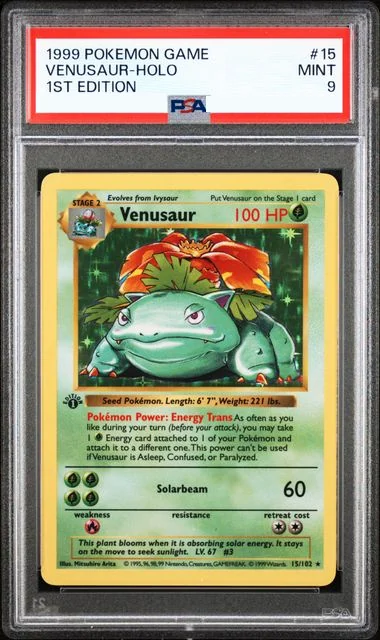
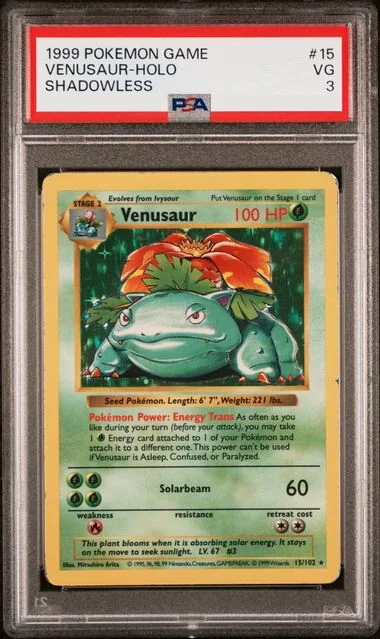
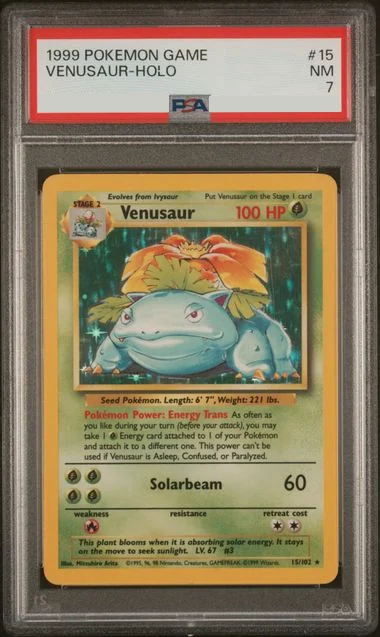
We have owned three copies of the same card — Venusaur, number 15 in the 1999 Base Set. One is a 1st Edition, one is Shadowless, one is Unlimited. Same artwork, same set, same year printed on the label. At the same grade, the first is worth roughly twelve times the third!
1st Edition · PSA 9
Shadowless · PSA 3
Unlimited · PSA 7
What the stamp is
A small black circle with a 1 inside it and the word EDITION curved around the top. PSA puts it plainly: on English cards it sits near the lower-left corner of the card art box (PSA Pokémon Collecting Basics). It is printed on the card itself!
For English sets it means one thing: this card came from the first print run of that set. Nothing about condition, nothing about rarity within the set. A 1st Edition common is still a common.
Thin stamp, thick stamp
Not every 1st Edition stamp looks the same, and collectors sort them into thin and thick. The names are about one thing only: the width of the numeral 1 inside the circle. A wide 1 is a thick stamp. A narrow 1 is a thin stamp — and on a thin stamp the word EDITION is actually the heavier of the two, which is why the naming confuses people (Elite Fourum).
Thick stamp · PSA 9
Thin stamp · PSA 8
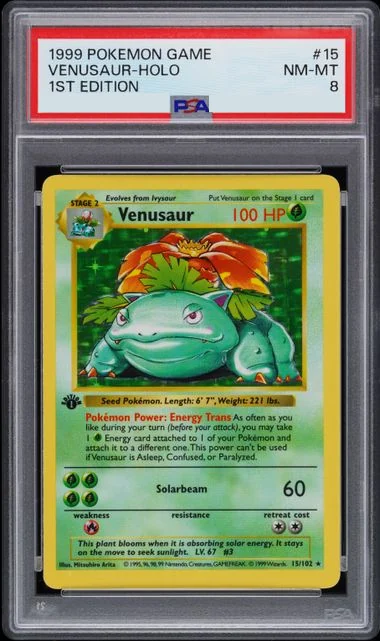
The order matters. It is believed the English Base Set 1st Edition run started with thick stamps. Following that the thin stamp followed on Base Set holos. It then became the standard for every English set that followed — Jungle, Fossil, Team Rocket, the two Gym sets and the four Neo sets. So on a Base Set non-holo, a thick stamp is the ordinary thing to see.
The genuinely scarce combination is a thin stamp on a Base Set non-holo, which that same catalogue calls “extremely hard to find, and almost non-existence,” possibly from only one or two printing sheets. Grey and back-imprinted stamps are also documented, and are explained as sheets being stacked before the stamp ink had dried (Elite Fourum).
Neither source we used puts a price premium on thin over thick, so treat it as a collector distinction worth knowing. Not as a number you should assume. And do not mix it up with the thin and thick HP text further down this page — that is a different feature, on a different part of the card, doing a different job.
If you only remember one thing: no stamp means not 1st Edition. There is no such thing as a 1st Edition card whose stamp was left off. That card has a different name, and you are about to meet it.
Base Set is the one that trips everybody
For every set except Base Set, the stamp is the whole story: stamp or no stamp. Base Set had four print runs, and the stamp came off before the design changed. That left a middle group of cards that look like 1st Editions except for the missing stamp. Those are Shadowless.
PSA describes Shadowless as a printing found only in the 1999 Base Set: after the 1st Edition run finished, the stamp was removed while the missing shadow and the thin HP font stayed (PSA). The shadow and the thicker text came later.
| Base Set print run | Stamp | Shadow | HP text | Notes |
|---|---|---|---|---|
| 1. 1st Edition (Shadowless) | Yes | No | Thin | The first English print run. |
| 2. Shadowless | No | No | Thin | Same plates, stamp removed. |
| 3. Unlimited | No | Yes | Thick | Shadow added, HP text thickened. |
| 4. Unlimited ©1999–2000 | No | Yes | Thick | Identical to run 3 but for the copyright line. |
So all 1st Edition Base Set cards are shadowless, but not all shadowless Base Set cards are 1st Edition. That sentence is worth reading twice, because getting it backwards is what makes someone believe a $200 card is a $5,000 one.
1st Edition
Shadowless
Unlimited
Checking a card in ten seconds
In this order, because each step rules out more than the last:
- Is it already graded? Read the label and stop. PSA writes 1ST EDITION or SHADOWLESS on the line under the card name. A blank line means Unlimited. The grading company’s opinion is the one the market pays for, so there is nothing left to work out.
- Look under the left corner of the artwork. Circle with a 1 in it, EDITION arched over the top. If it is there, you are done — it is 1st Edition.
- No stamp? Look down the right edge of the artwork window. A dark shadow band means Unlimited. No shadow, and you are looking at a Base Set Shadowless.
- Sanity-check with the HP text. Shadowless and 1st Edition use a thinner font for the name and HP than Unlimited does. It is a useful second opinion when the shadow is hard to judge in a photo.
- Then check the set. Plenty of sets never had a 1st Edition run at all, so if the set is on the wrong side of that list, no amount of squinting will help.
Which sets even have one
Ten English Wizards of the Coast sets had a 1st Edition print run:
- Base Set
- Jungle
- Fossil
- Team Rocket
- Gym Heroes
- Gym Challenge
- Neo Genesis
- Neo Discovery
- Neo Revelation
- Neo Destiny
Japanese cards are their own conversation. Japanese sets did get 1st Edition printings — the two sets behind Skyridge were released in Japanese in both 1st Edition and unlimited. But the very first Japanese Base Set cards are identified a different way entirely: the earliest run has no rarity symbol in the bottom-right corner, and it carried errors later corrected, including Venusaur printed as Pokémon #68 instead of #3. If you have a Japanese Base Set card, the missing symbol is what you want to look for, not a stamp.
How much smaller was the first run, really
Honestly: nobody knows. The number people repeat is fewer than 10,000 of each card, and it comes from PSA’s own Set Registry write-up — which says in the same breath that the exact number produced is unknown, and that 1st Edition stock sold out almost overnight (PSA Set Registry). Collectors have argued that estimate back and forth for years without landing on a figure. Anyone quoting you a precise print run is guessing.
What we can check is how many have been graded, because PSA publishes that. Our Venusaur in two printings, with the 1st Edition Charizard underneath it for scale:
| PSA CardFacts | Total graded | PSA 10 |
|---|---|---|
| Venusaur-Holo (1st Edition) #15 | 3,232 | 144 |
| Venusaur-Holo #15 (Unlimited) | 36,401 | 579 |
| Charizard-Holo (1st Edition) #4 | 4,829 | 124 |
Roughly eleven Unlimited Venusaurs graded for every 1st Edition one.
Three mistakes we see every week
- “1999” read as 1st Edition. Every Base Set card says 1999, all four print runs. The year tells you the set, not the run.
- Shadowless sold as 1st Edition. Usually not dishonest — the two look nearly identical and the seller genuinely believes it. It is still a different card at a different price, so check the stamp yourself rather than taking the title’s word.
- Judging from the listing title instead of the card. We price from the slab label and the photo, never the title. Titles leave out the printing far more often than they state it wrongly.
We are buyers, not graders, and this is our reading of published sources rather than a grading standard. Spot something wrong and we will fix it — sell@orbley.com.
Sources
Everything above comes from these, whether or not it is linked in the text.
- PSA, Pokémon Collecting Basics Guide PSA’s own definitions of 1st Edition, Shadowless and Unlimited, the stamp’s position, the thin and thick HP font, and the printing order.
- PSA Set Registry, “Collecting the 1999 Pokémon 1st Edition Gaming Card Base Series” The estimate of fewer than 10,000 of each card, the note that the true number is unknown, and the 11-card 1st Edition booster pack.
- Bulbapedia, Base Set (TCG) The four English Base Set print runs in the table above, and the thin and thick stamp varieties being named for the width of the numeral 1.
- Bulbapedia, Expansion Pack (TCG) The Japanese No Rarity Symbol first print run, including Venusaur being printed as #68 instead of #3.
- Bulbapedia, Skyridge (TCG) The Japanese sets behind Skyridge had both 1st Edition and unlimited printings.
- Elite Fourum, “1st edition stamp variations” The list of English sets with a 1st Edition print run; that the Base Set run started with thick stamps while the holos carry thin ones; that thin became the standard for every later English set; that a thin stamp on a Base Set non-holo is ‘extremely hard to find’; and the grey and back-imprinted stamps caused by stacking sheets before the ink dried.
- PSA CardFacts, 1999 Nintendo Pokémon Game The population figures quoted above, read on 22 September 2026.
- PriceCharting, Venusaur #15 — 1st Edition and Unlimited The ‘roughly twelve times’ figure in the opening: $5,921.76 for the 1st Edition against $486.09 for the Unlimited at grade 9, read on 22 September 2026.
Not sure which one you have?
Send a straight-on photo of the front and we will tell you which printing it is and what it is worth, with the comparable sales we used to get there. No fees, and we send you a prepaid shipping label.
Get an offer