The “double holo” variant, explained
One line on a PSA label can change what a card is worth. Here is what “double holo error” means, why the name can be misleading without context.
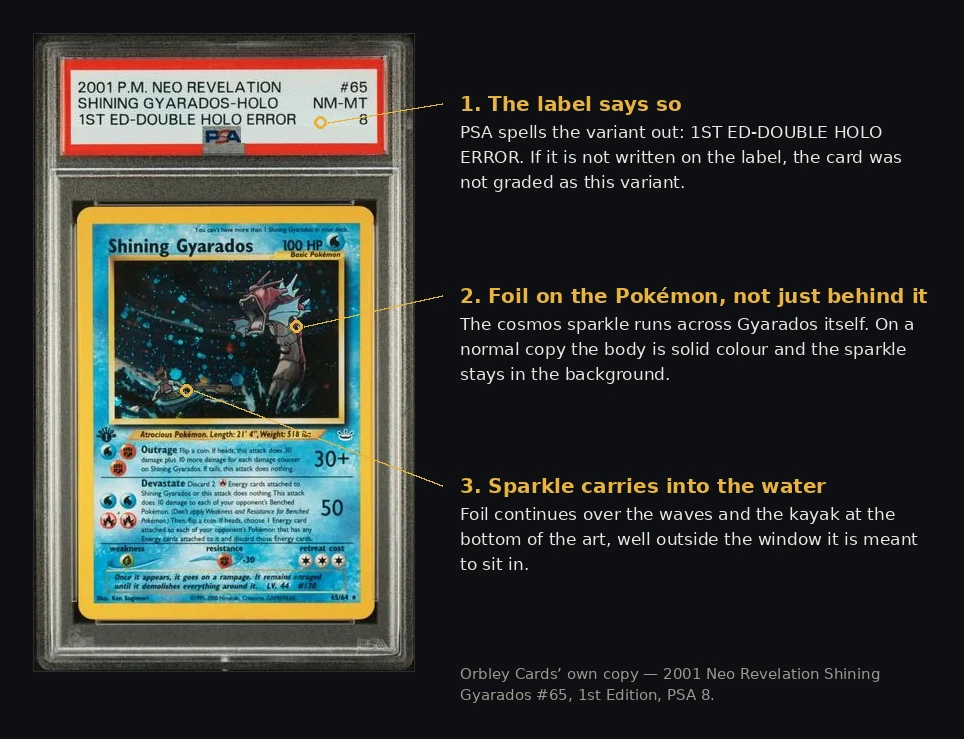
We bought a 2001 Neo Revelation Shining Gyarados in 2023. The card itself is well known. The third line of the label is the part most people have to look up: 1ST ED–DOUBLE HOLO ERROR.
It is a real, catalogued variant that both PSA and CGC now put on the label — not a nickname a seller invented. But it is also one of the most misunderstood terms in vintage Pokémon, including by us until we went and read up on it properly.
Double holo error · PSA 8
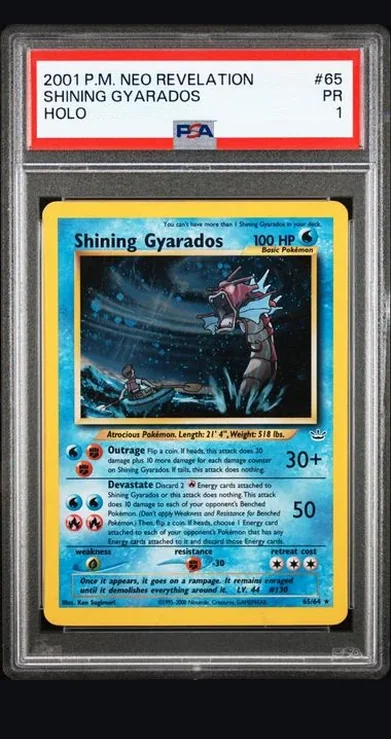
Standard holo · PSA 1
It is not a second layer of foil
The name suggests the card got twice the holo. That is the natural reading, it is how most listings describe it, and it is wrong. Collectors who have compared these side by side are blunt about it — the long-running thread on Elite Fourum states plainly that these cards do not have a second holo layer and that the amount of foil is the same. Many of them prefer the term holo bleed.
What is actually different is the layer nobody thinks about. A holo card is built with a sheet of holofoil underneath, and then a layer of opaque white ink printed on top of it to block the foil everywhere it is not supposed to show. The artwork is printed over that. The white ink is the stencil: it decides where the card sparkles.
On these Neo Revelation cards that white layer was drawn differently, printed too thinly, or left less opaque than normal, so foil shows through in places it was never meant to — across the Pokémon, into the water, past the edges of the art window. Same foil, less stencil.
A normal copy
A “double holo”
Why it matters if you are selling: two copies of the same card, same grade, can be catalogued as different products entirely. Look up the wrong one and your number will be wrong by hundreds or thousands of dollars.
Which cards, and which printings
It is a Neo Revelation thing — the 2001 English set, the one with Shining Gyarados and Shining Magikarp as secret rares. PSA describes the error as affecting several cards in that set, with the foil extending outside the normal areas, and uses Ho-Oh as its example: the foil runs into Ho-Oh’s wings instead of staying in the background (PSA Pokémon Error Guide).
CGC went further and now recognises the variant across all 16 holofoil cards in the set. Names that come up most often are Ho-Oh, Houndoom, Celebi, Crobat, Misdreavus, Suicune, Raikou, Entei, Shining Magikarp and Shining Gyarados.
Two things narrow it down further, and both are easy to get wrong:
- English only. The German, French and Italian Neo Revelation printings do not have that opaque white layer behind the background at all, so every copy looks like a double holo. Because there is nothing to compare it to, it is not treated as a variant in those languages (Elite Fourum).
- 1st Edition is the rare one. The variant exists in both 1st Edition and Unlimited English, and the 1st Edition version is much scarcer. One dealer who sent a batch in for grading estimated roughly 5% of the 1st Edition print run carries it, while noting nobody has published a real figure (The Card Collective).
- There is no double holo in other sets. Cosmos foil bleeding onto the Pokémon happens on plenty of e-Series cards — Expedition, Aquapolis, Skyridge — and it is not a recognised variant there. If someone is selling a “double holo” Skyridge card, the term is being borrowed, not quoted.
How to check a card you own
If it is already graded, read the label and stop there — PSA and CGC both write it out, and a grader’s opinion is the one the market pays for. If the card is raw, or the label does not mention it, this is what people look at:
- Look at the Pokémon, not the background. On a normal copy the body is solid printed colour. On these, the cosmos sparkle runs across it.
- Check the outline. Standard copies usually carry a thin white halo where the masking ink sits around the Pokémon. On the variant that halo is often missing or looks very different.
- Watch for foil outside the art window. Sparkle in the water, on the rocks, over the ground, or past the border of the illustration is the giveaway.
- Scan it. Collectors repeatedly warn that the difference is subtle in hand and much more obvious in a flatbed scan or a straight-on photo. If you are not sure in person, that is normal.
- Expect degrees, not a yes or no. There are in-between copies with partial bleed that do not look as dramatic as the strong examples. Grading companies still have to make a call on those.
We are buyers, not graders, and this is our reading of published sources rather than a grading standard. Spot something wrong and we will fix it — sell@orbley.com.
Sources
- PSA, Pokémon Error Guide PSA’s own description of the Neo Revelation double holo error, using Ho-Oh’s wings as the example.
- Elite Fourum, “Is PSA Recognizing Holo Bleed Neo Revelation Cards?” The collector discussion that explains the printing mechanism and argues the name is a misnomer.
- Elite Fourum, “CGC Cards now recognizing Double Holo Neo Revelation variants” CGC recognising all 16 holofoil variants, with label photographs.
- Elite Fourum, “What to look for in regards of double holo Shining Gyarados” The twelve Shining Gyarados variants, the German, French and Italian printings, and the “flip a coin” error.
- The Card Collective, “PSA Return: Neo Revelation Double Holo Error” A dealer’s grading return, and the estimate that around 5% of the 1st Edition print run carries it.
Think you have one?
Send photos — a straight-on shot of the front is enough to start — and we will tell you which variant it is and what it is worth, with the comparable sales we used to get there. No fees, and we send you a prepaid shipping label.
Get an offer